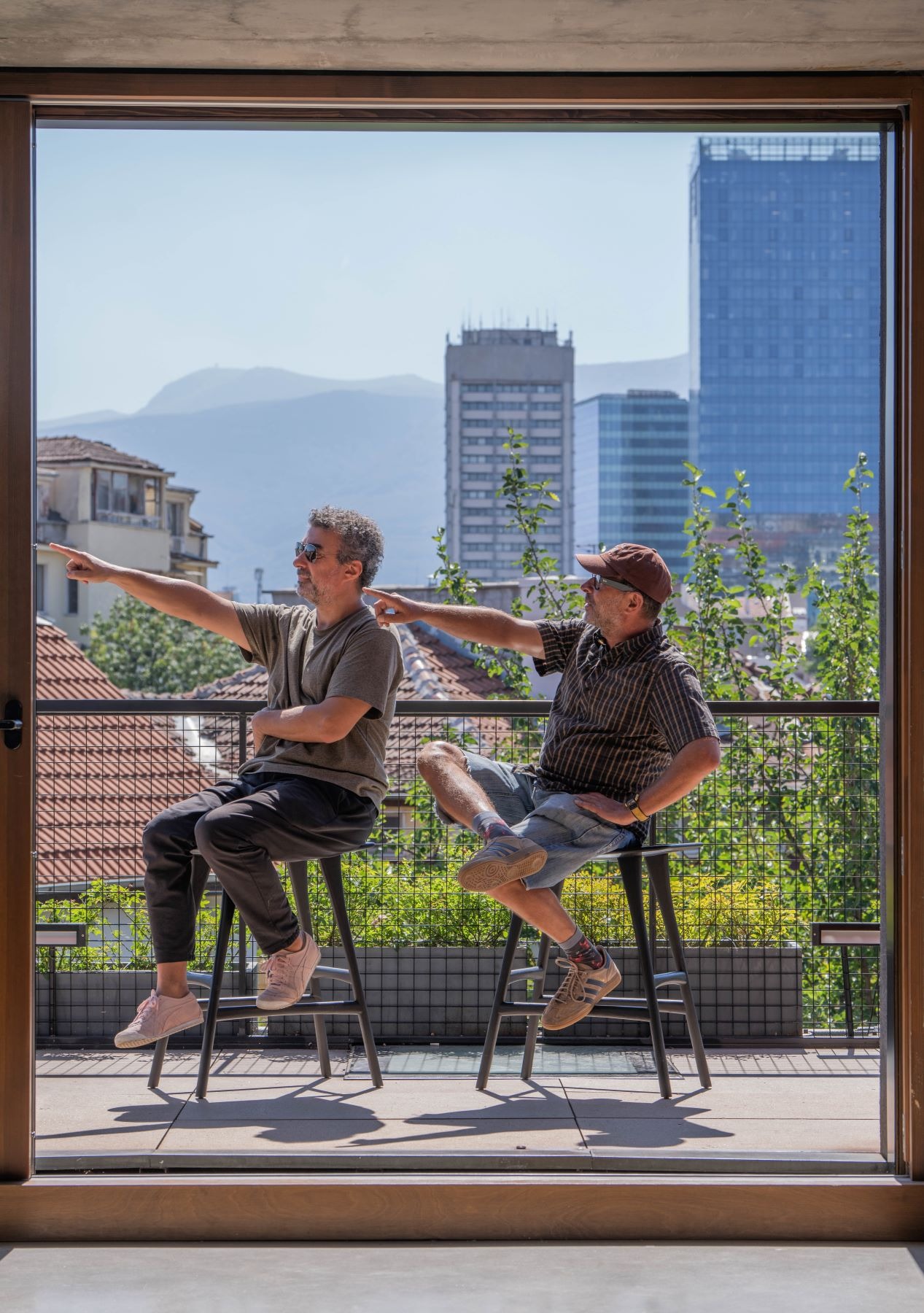
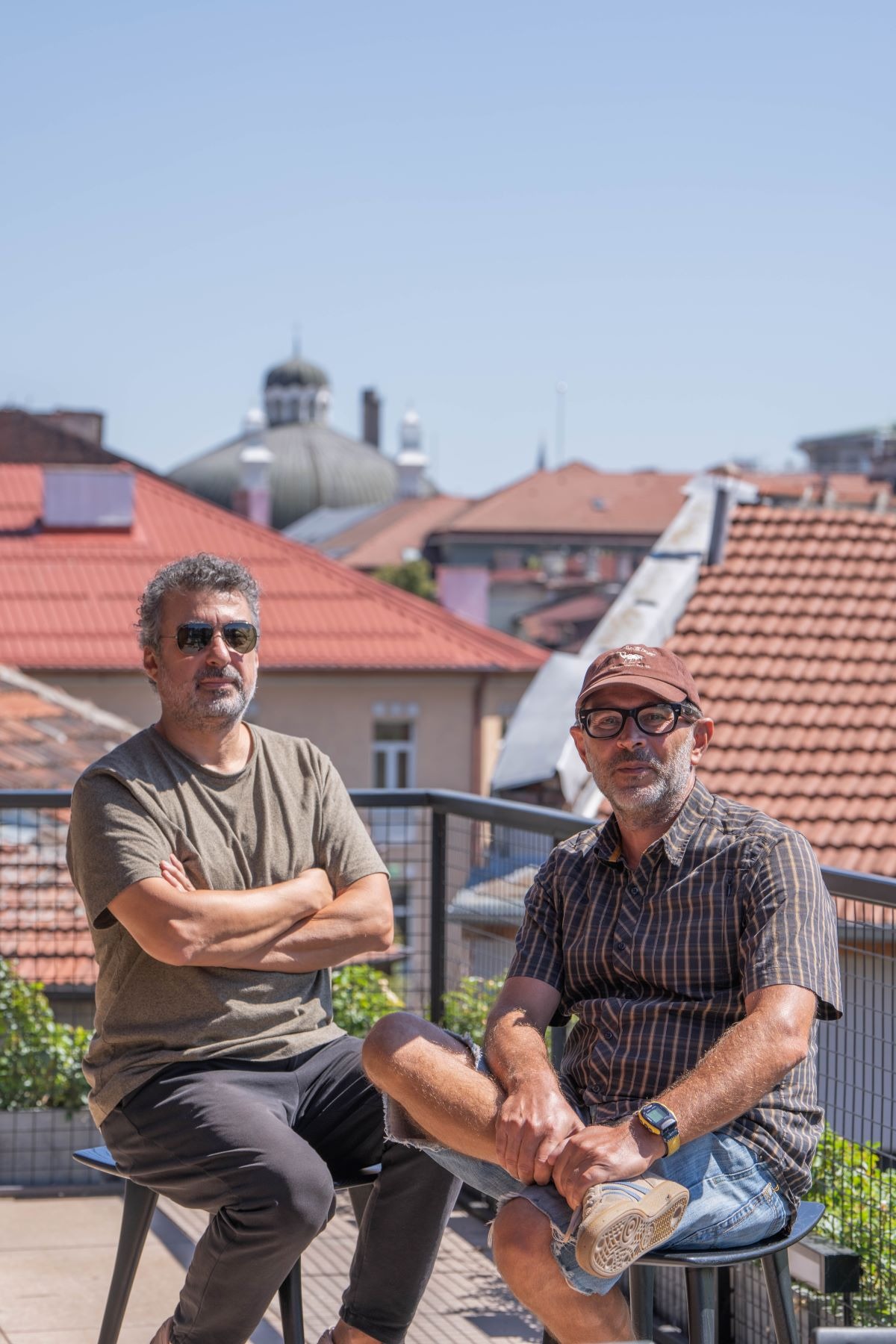
Just days before the closing of “The Women’s Market Choir” exhibition on October 10, we speak with Georgi Bogdanov and Boris Missirkov about the characters who keep returning, encounters across decades, and the many faces of the market as a microcosm of the world.
The exhibition is part of the long-term “SOFIA STATION” programme of DOT Sofia Art Collection.
The “SOFIA STATION” series began with Panayot Burnev’s archival photographs. We then saw the market through the documentary lens of Konstyo Valkov, and now we hear the voice of the Women’s Market through a large-scale installation. How did the idea for “The Women’s Market Choir” come about?
B.M.: Perhaps it was born mainly from the idea that we didn’t want to take photographs of the Women’s Market. In our minds, simply making another documentary series couldn’t produce something new or particularly intriguing.
G.B.: When we were invited some time ago, the original idea was for us to create a photographic series. Today, I don’t think we could make anything particularly interesting in that form. I think we’ve said everything we can say through documentary photography, in the way we work and tell stories. For us, too, it had to be something challenging and exciting to make. Because eventually there comes a point in life when you’ve done a lot of things, a lot has happened to you, and it becomes increasingly difficult to arrive at something genuinely new. In the end, the main thing is to challenge yourself. So we decided to create a more poetic narrative – a work that would be cast in a different form and would be, in some way, the least expected thing from us.
B.M.: We had actually worked with the Women’s Market many years ago. When we were making the Explore Bulgaria series for National Geographic, we had an entire episode dedicated to the market. We walked around it extensively with Drago Simeonov and met all kinds of characters.
So this isn’t your first artistic encounter with the Women’s Market, but another one – this time through a new approach.
B.M.: Yes. This time it happens through this “puzzle” that we created over several months. It’s something like a 25-minute multichannel film unfolding simultaneously across 50 small screens.
What brings the Women’s Market Choir together? And what else can be heard in this story?
B.M.: Perhaps the one thing all the characters have in common is that they are in love with the market and, at the same time, hate it.
G.B.: The truth is that this isn’t a second encounter for us. For someone who lives in Sofia, lives in and with the markets, these encounters are constant. In a sense, you are at home here, and when you come here, you encounter the whole of Sofia. You never really stop doing that. You know some people literally because you’ve bought things from their stalls. You’ve met others in the strangest places... The market is a place that is absolutely at the centre of everything – of the people who love it and hate it, who make their living from it but also somehow can’t leave it. They have been the core of this place since the very beginning.
B.M.: I remember the market from when I was a child – my grandmother lived further up “Bratya Miladinovi” Street...
And how do you see the market today?
B.M.: One thing is the obvious gentrification – the fact that the market has become a tourist destination, and some of our characters are people who make a living specifically by serving tourists. Whether by selling them traditional Bulgarian banitsa and boza as a kind of “surprise”, or by taking them on tours around the neighbourhood.
The other thing they say is that people have simply become poorer and are buying less. This is where people who can’t afford the more expensive shops come.
What, then, makes the market difficult to “digest”?
G.B.: For quite a few people, it is like their homeland. Some are second-, third-, even fourth-generation. Take Uncle Stani’s rope business, for example – his daughter-in-law is the fourth generation of her family to work in this trade. Like a homeland, you can’t simply give it up. For these people, I don’t think the market is necessarily difficult to digest. They have their own mantra about it. Every morning they get up at three or four, some of them come from very far away, to sell whatever produce they have.
We focused on the area between Bratya Miladinovi and Boris, in this broader stretch, rather than on the market strictly as a collection of stalls. We included everything around it as well – barbershops, butcher shops, spice stores, bicycle workshops, one-leva shops...
As authors, I don’t think it is difficult for us to digest. We’re simply going to digest it in a different way this time. And perhaps it won’t be the last time, but for now, this is it.
Among all the encounters and stories you have collected, do you have a favourite character?
G.B.: Above all, it’s very specific because you spend some time with a person and you become incredibly grateful to them for giving you their time, for agreeing to go along with the things you ask them to do. Because it’s not easy for someone to come and ask you to talk in front of strangers and then ask whether you’ll sing for them.
Meanwhile, you’re selling two tomatoes, two pairs of socks, sitting at your stall. For that person, it may be half an hour of their life. But afterwards, we begin, as we do with every film, to live with these people, to love them. They become your characters. If you don’t love your character, it’s difficult to tell their story. It’s funny that, some time later, they might not recognise us on the street if they see us. But for us, they are people we’ll greet with a “good morning” – as if they were family. They are all important to us, even though some stories are particularly interesting.
B.M.: Perhaps we are most grateful to those who allowed themselves to show emotion while we were filming them – to cry, or to say something deeply personal that they otherwise wouldn’t have shared.
Did they have any idea what they were actually getting themselves into – or not quite?
G.B.: And that’s the most wonderful part: they choose to trust you and give you something of themselves.
Could you tell us something about one of the encounters that particularly stayed with you – for those who have already seen the work?
For us, one of the most moving encounters was with someone we had seen, roughly speaking, a quarter of a century ago, in a completely different place. From the very beginning, he clearly recognised us, while it took us some time – and only after he recognised us did we remember him.
Back then, he was a young man. Today, he is our contemporary, so to speak. We met him in 2002–2003, during the filming of “Georgi and the Butterflies”, directed by Andrey Paunov, in Podgumer. Toshko was a resident of the psychiatric care home in Podgumer and still lives there today, but he is well enough to come into the market and work during the day. Some people here have taken him in at their stall – he works in their warehouse. After almost 25 years, you meet someone again here, you start talking, and you realise that perhaps you have been some small part of each other’s lives throughout all those years.
The story with the ropes was funny, too. The film Lust had just come out. We had seen it and really liked it. One day we found ourselves with Uncle Stani, at the rope stall, talking to his daughter-in-law about all kinds of things. At some point, we asked her what kind of unusual customers they get. She told us: “Lately there’s been a trend – some people order special ropes made of natural materials so they can go and tie each other up, some kind of sexual practices.”
I suddenly felt that we were no longer living in Sofia – we were living in Berlin and were actually right in the middle of the action :))
B.M.: Yes, because in the meantime we had discovered that this is quite a popular activity in Berlin and across the Western world.
What might surprise someone who already knows the Women’s Market?
B.M.: Perhaps the fact that, for the first time, we get to see these people and experience them as individuals, with their own destinies, worries and pain – rather than simply as the person standing behind a stall.
G.B.: I believe our perspective here is completely different, and that this should matter. At times, the human voice itself is even decomposed. In the end, each person becomes a fragment of one collective portrait, one larger whole. We’ve had this problem all our lives: we can’t seem to make anything truly ugly. This work is like that, too. It isn’t necessarily made up of beautiful stories, beautiful people and beautiful landscapes – quite the opposite: difficult lives, people who may not conventionally look beautiful, and so on... But in the end, brought together, they create something beautiful.
If you had to describe this melody in simple words, what would it sound like?
G.B.: No, you can’t. You really have to hear it for yourself. It can’t be described in words. If someone tries to put it into words, they might ruin it – because words simplify things too much.
An emotion told in words is no longer the same emotion. It is a melody that began with the voices – that’s what I can say. Decomposed, brought together and reworked, it ultimately moves towards its conclusion.
Today we are at DOT Sofia – another character in our story. What was your first encounter with this place?
B.M.: We’ve been friends with Vyara and Zhoro Katovi for years, so we were very happy to see what they had created here.
How would you describe DOT?
B.M.: Personally, I’d say it’s a wonderful piece of swagger – and if I had been the one to create it, I’d be pretty happy too.
G.B.: A slightly cheeky but polite experiment. In any case, with a great deal of respect for absolutely everything here. It’s funny that it feels like something that has been prematurely aged, as if it had been standing here for hundreds of years, and yet it is new.
B.M.: We’ve also worked several times on bringing old spaces back to life, giving them a new appearance and a new purpose while respecting their history. So we’re a little jealous of Pancho :))
And my final question: what would you like to see happen – and see more often – in this neighbourhood that you know so well, beyond the project you are working on now?
G.B.: I don’t think there’s anything I’m particularly missing. If I had a time machine, perhaps I would remove all the newly built apartment buildings and bring back the old houses, so that their poor owners could renovate them. Maybe there could also be a little more care for the market stalls themselves, which have ultimately been neglected after the last major renovation. But whatever doesn’t happen with the help of the state somehow happens naturally, organically, with the market itself – it finds a way to take care of itself.
Photo credit: Stefan Shterev